
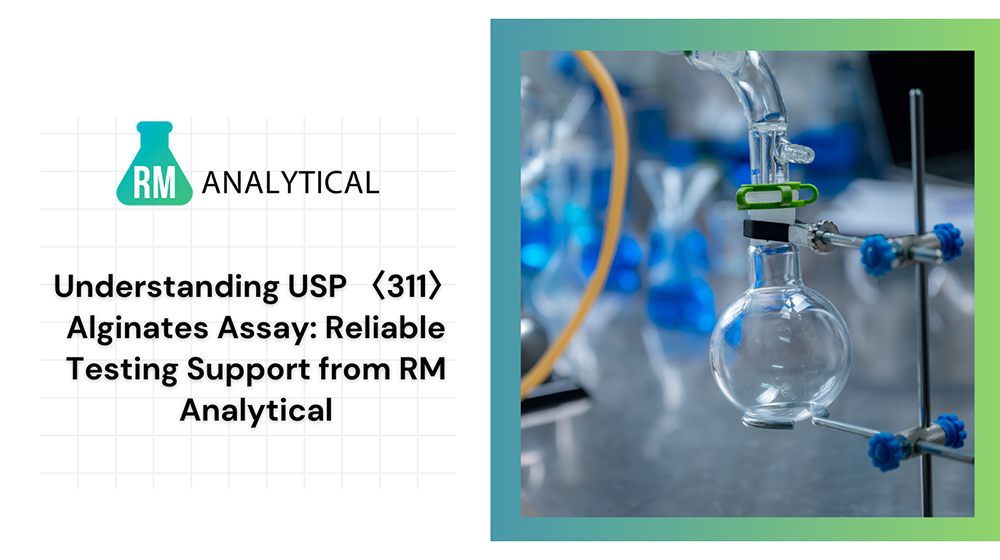
Alginates are widely used pharmaceutical excipients known for their thickening, stabilizing, and controlled-release properties. Because these materials play a critical role in product performance and quality, accurate analytical testing is essential to ensure compliance with pharmacopeial requirements and material specifications.
One of the key compendial procedures used to evaluate alginate materials is USP 〈311〉 Alginates Assay – a specialized analytical method designed to determine carbon dioxide content generated from alginate decomposition under controlled conditions.
What is USP 〈311〉 Alginates Assay?
USP 〈311〉 Alginates Assay is a classical wet chemistry assay used to quantify carbon dioxide (CO2) released during the reaction of alginate materials under acidic conditions.
The procedure involves:
- Controlled acid digestion
- Nitrogen purging
- Reflux heating
- Carbon dioxide collection in sodium hydroxide solution
- Back titration using standardized hydrochloric acid
The resulting titration data is used to calculate the percentage of carbon dioxide present in the sample, helping determine alginate content and material quality.
The method requires careful control of:
- Nitrogen flow rates
- Reflux conditions
- Gas transfer integrity
- Titration accuracy
- Blank corrections
- Moisture correction factors
Because of the multiple system components involved, the assay requires experienced analysts and properly maintained laboratory equipment to ensure reliable and reproducible results.
Importance of System Suitability
USP 〈311〉 includes detailed system suitability requirements intended to verify that the apparatus and analytical setup are functioning properly before sample analysis begins.
The procedure uses d-glucuronolactone as a standard material to confirm:
- Proper recovery of carbon dioxide
- Accurate titration performance
- Minimal system blank contribution
The method specifies acceptable recovery ranges for carbon dioxide and defines acceptable blank titration values, helping ensure analytical reliability and data integrity.
At RM Analytical, system suitability verification is treated as a critical component of assay execution to support robust and defensible analytical outcomes.
Challenges Associated with Alginates Testing
While USP 〈311〉 appears straightforward on paper, successful execution often requires extensive laboratory expertise due to:
- Complex glassware setup
- Gas-tight system requirements
- Precise flow control
- Long reflux times
- Sensitivity to leaks and contamination
- Accurate endpoint determination
- Proper handling of moisture correction factors
Even small procedural inconsistencies can significantly impact carbon dioxide recovery and final assay calculations.
Our laboratory team understands these challenges and applies rigorous controls throughout the testing process to maintain data quality and consistency.
At RM Analytical, we provide reliable USP excipient testing and analytical support for pharmaceutical materials and finished products under cGMP-compliant quality systems. Our experienced team helps clients navigate complex analytical and pharmacopeial requirements with confidence.
Our laboratory team understands the challenges associated with complex pharmacopeial testing and applies rigorous controls to ensure reliable, consistent, and high-quality data. At RM Analytical, we provide USP excipient testing and analytical support for pharmaceutical materials and finished products under cGMP-compliant quality systems, helping clients meet analytical and regulatory requirements with confidence.
Contact us today: engage@rawmaterialanalytical.com
Call us: 833-928-8333
Recent Blogs and News
Elemental Impurities Testing: Understanding USP <232>, USP <233>, and ICH Q3D
Elemental impurities in drug products can enter the manufacturing process through several pathways: as residual catalysts intentionally introduced during synthesis, as contaminants from interactions with processing equipment or container/closure systems, or as impurities already present in raw material components. Unlike active pharmaceutical ingredients, elemental impurities provide no therapeutic benefit to patients. In fact, they can...
Why Cleaning Validation is Non-Negotiable in Drug Manufacturing
THE FOUNDATION What Is Cleaning Validation in Pharmaceuticals - and Why Does It Matter? When pharmaceutical equipment moves from one production run to the next, the stakes could not be higher. Trace residues of active pharmaceutical ingredients (APIs), cleaning agents, or byproducts can quietly alter a drug's strength, composition, or effectiveness - putting patients at...
Understanding USP 〈311〉 Alginates Assay: Reliable Testing Support from RM Analytical
Alginates are widely used pharmaceutical excipients known for their thickening, stabilizing, and controlled-release properties. Because these materials play a critical role in product performance and quality, accurate analytical testing is essential to ensure compliance with pharmacopeial requirements and material specifications. One of the key compendial procedures used to evaluate alginate materials is USP 〈311〉 Alginates...