
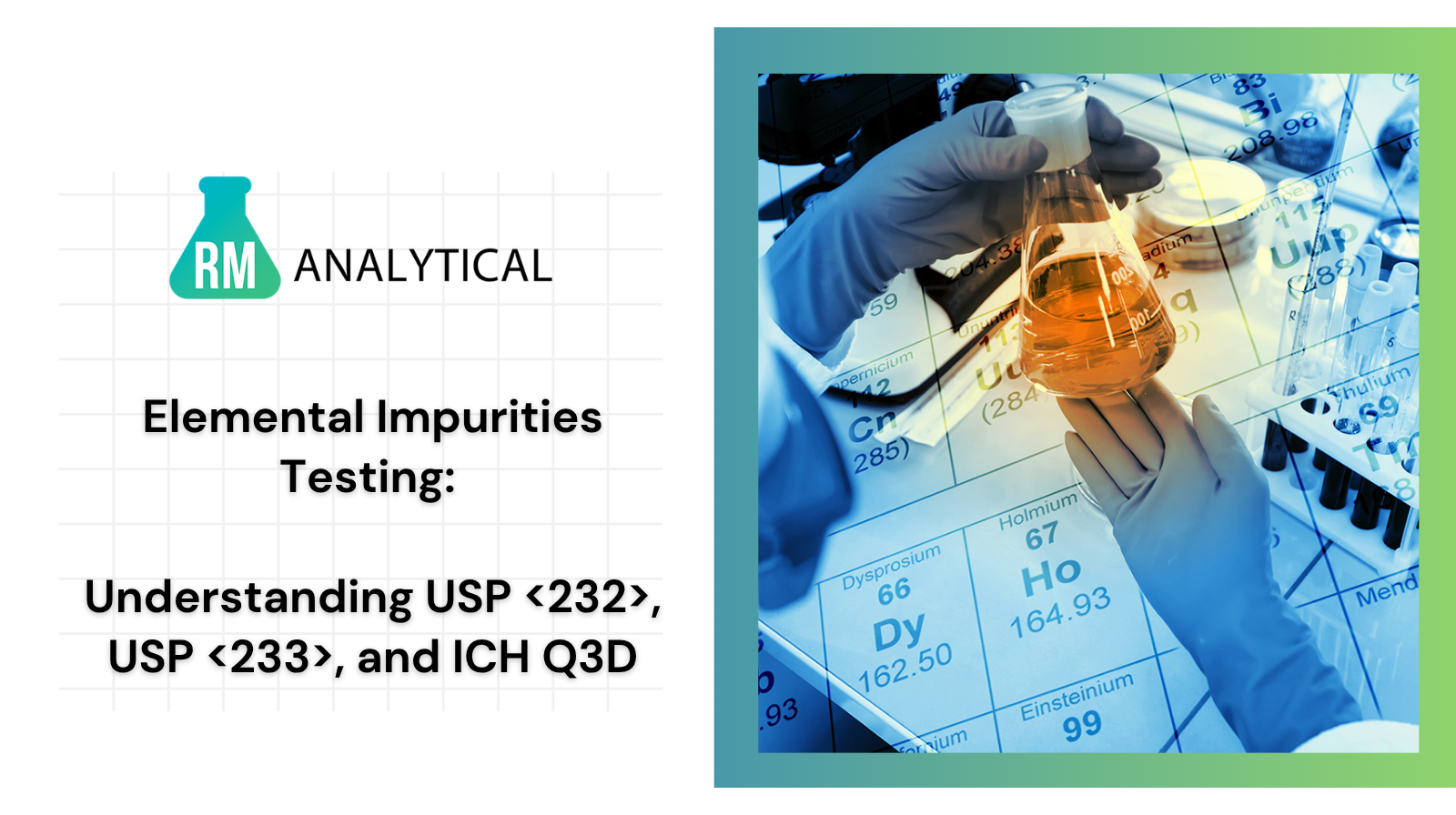
Elemental impurities in drug products can enter the manufacturing process through several pathways: as residual catalysts intentionally introduced during synthesis, as contaminants from interactions with processing equipment or container/closure systems, or as impurities already present in raw material components.
Unlike active pharmaceutical ingredients, elemental impurities provide no therapeutic benefit to patients. In fact, they can cause serious harm, adversely affect drug stability and shelf life and potentially leading to unwanted side effects in the end user. For these reasons, elemental impurities must be rigorously monitored and controlled across drug substances, intermediates, excipients, and finished drug products.

From USP <231> to a Modern Risk-Based Framework
For nearly a century, the pharmaceutical industry relied on the colorimetric technique defined in USP <231>, commonly known as Heavy Metals Testing, to detect elemental impurities. That approach has since been replaced.
The United States Pharmacopeia (USP) introduced General Chapters <232> and <233> to establish a more comprehensive, scientifically sound standard for monitoring and controlling elemental impurities. These chapters align with the International Council for Harmonization (ICH) Guideline Q3D, which provides a global framework for developing risk-based control strategies specific to each drug product.
What USP <232> Covers
USP <232> expands significantly on the scope of its predecessor. It addresses a broader range of analytes, including catalysts and contaminants from raw materials, manufacturing processes, the environment, and container/closure systems, and takes a risk-based approach to regulatory compliance.
Elements are grouped into three classes based on their toxicity and probability of occurrence in a drug product:
- Class 1: Elements of high toxicity with significant likelihood of inclusion (e.g., arsenic, cadmium, lead, mercury)
- Class 2A & 2B: Elements with moderate toxicity, differentiated by their likelihood of occurrence through oral, parenteral, or inhalation routes
- Class 3: Elements with lower toxicity relative to Classes 1 and 2, but still subject to control
This classification scheme focuses the risk assessment where it matters most, on the elements most likely to be present and most harmful to patients.
Permitted Daily Exposures (PDEs)
ICH Q3D and USP <232> establish Permitted Daily Exposures (PDEs) for each element across all three classes. PDEs represent the maximum acceptable daily intake of an elemental impurity and are determined based on chronic exposure data for three routes of administration: oral, parenteral, and inhalation.
By combining the PDE for a given element with the maximum allowable daily dosage of a specific drug product, manufacturers can calculate the permitted concentration of that element in their product, forming the quantitative foundation of the risk-based control strategy.
Analytical Methods: USP <233>
USP <233> defines the analytical procedures used to evaluate elemental impurity levels and establishes acceptance criteria for both Limit Test and Quantitative procedures. The chapter endorses the use of modern multi-element instrumentation, specifically ICP-MS (Inductively Coupled Plasma Mass Spectrometry) and ICP-OES (Inductively Coupled Plasma Optical Emission Spectrometry), for their sensitivity, specificity, and efficiency in detecting trace-level impurities across a wide range of elements simultaneously.
How RM Analytical Can Help
RM Analytical offers comprehensive elemental impurities testing in full compliance with USP <232>, USP <233>, and ICH Q3D, including Trace Metals Analysis for drug substances, excipients, container/closure systems, and finished drug products.
Our team of experienced scientists utilizes state-of-the-art ICP-MS and ICP-OES instrumentation in a cGMP, FDA-registered, and FDA-audited laboratory environment. Whether you need support with risk assessments, method development, routine testing, or regulatory submissions, RM Analytical has the expertise to keep your program on track.
Get in Touch
Email: engage@rawmaterialanalytical.com
Phone: 833-928-8333
Recent Blogs and News
Elemental Impurities Testing: Understanding USP <232>, USP <233>, and ICH Q3D
Elemental impurities in drug products can enter the manufacturing process through several pathways: as residual catalysts intentionally introduced during synthesis, as contaminants from interactions with processing equipment or container/closure systems, or as impurities already present in raw material components. Unlike active pharmaceutical ingredients, elemental impurities provide no therapeutic benefit to patients. In fact, they can...

Why Cleaning Validation is Non-Negotiable in Drug Manufacturing
THE FOUNDATION What Is Cleaning Validation in Pharmaceuticals - and Why Does It Matter? When pharmaceutical equipment moves from one production run to the next, the stakes could not be higher. Trace residues of active pharmaceutical ingredients (APIs), cleaning agents, or byproducts can quietly alter a drug's strength, composition, or effectiveness - putting patients at...
Understanding USP 〈311〉 Alginates Assay: Reliable Testing Support from RM Analytical
Alginates are widely used pharmaceutical excipients known for their thickening, stabilizing, and controlled-release properties. Because these materials play a critical role in product performance and quality, accurate analytical testing is essential to ensure compliance with pharmacopeial requirements and material specifications. One of the key compendial procedures used to evaluate alginate materials is USP 〈311〉 Alginates...