Water content, often referred to as moisture content, is a critical quality attribute in pharmaceutical raw materials. Accurate water determination is essential to ensure product stability, regulatory compliance, and patient safety across the manufacturing lifecycle.
Many pharmaceutical substances exist as hydrates or contain adsorbed moisture. Because of this, pharmacopeial standards require precise water content testing using validated analytical methods tailored to the nature of the material.
The Importance of Moisture Control in Raw Materials
Even trace amounts of water can significantly impact pharmaceutical products. Controlling moisture content in raw materials is essential for the following reasons:
- Ensures Chemical Stability
In raw materials, water can trigger degradation pathways such as hydrolysis, leading to reduced potency and shorter shelf life.
- Prevents Microbial Growth
Moisture control in raw materials helps prevent contamination from entering the manufacturing process. Excess moisture can lead to bacterial or fungal growth.
- Maintains Physical Integrity
Water content directly impacts raw material behavior during manufacturing:
- Ensures proper powder flow and compressibility
- Supports consistent processing performance
- Supports Accurate Dosage
Consistent moisture levels verified in raw materials are critical to maintaining dose uniformity and product consistency.
- Enables Process Control
Moisture data from raw materials informs manufacturing processes such as granulation and drying, helping ensure consistent product quality.
Pharmacopeial Requirements in Raw Materials
Pharmacopeial monographs define the requirements for water determination in raw materials depending on the nature of the material.
- When water is part of the structure (for example, in hydrates) results are reported under water content.
- When weight loss may include other volatile substances, the test is reported as loss on drying.
These distinctions are essential for accurate interpretation during raw material testing and quality control.
Choosing the Right Approach for Water Determination
Selecting the appropriate method for water determination depends on:
- Material characteristics such as solid, liquid, or hygroscopic nature
- Expected moisture levels such as trace or high levels
- Potential interference from other volatile compounds
Key Methods Used in Raw Materials
Karl Fischer Titration
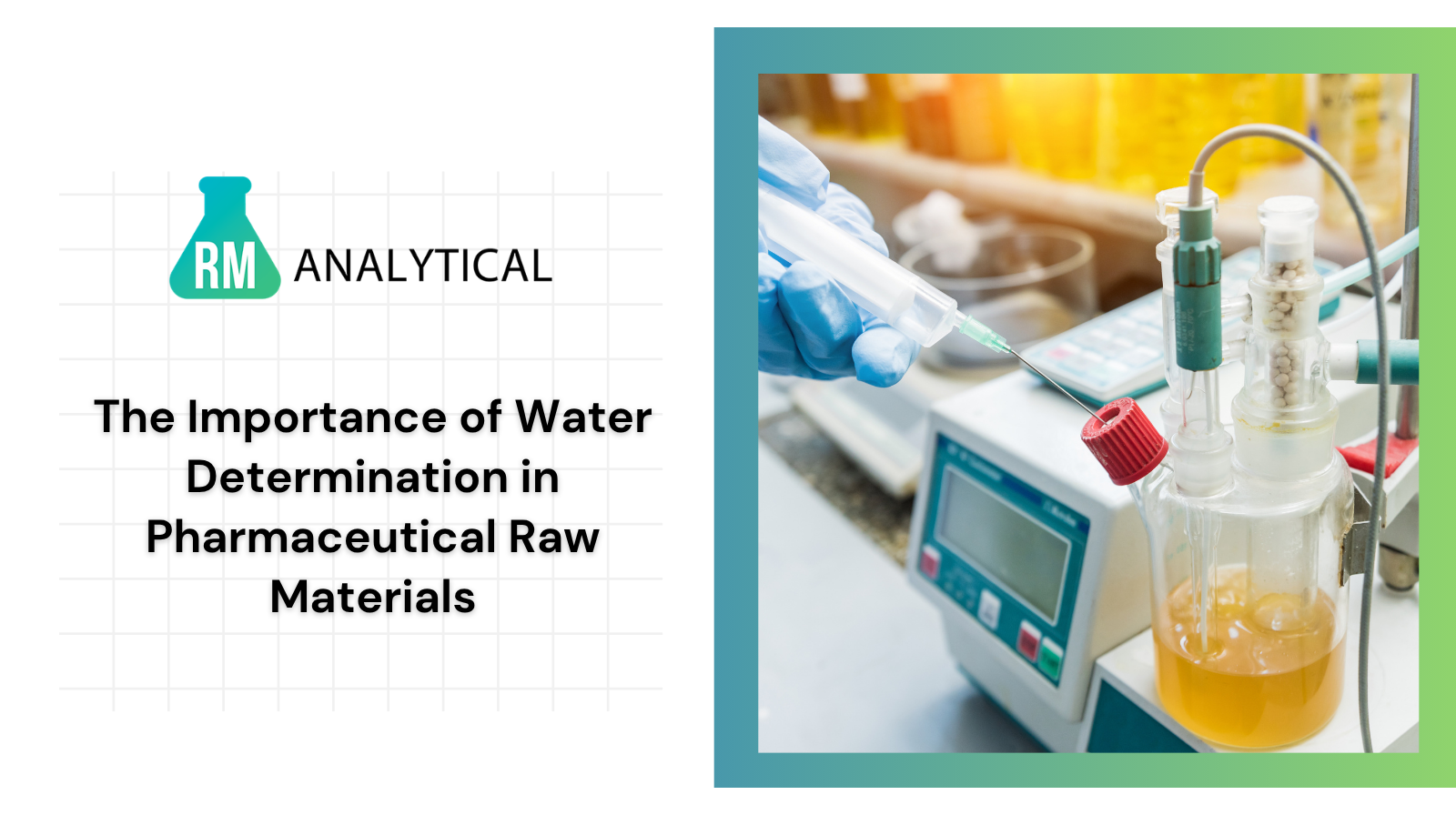
Karl Fischer titration is the most widely used method for water determination in raw materials. This method is especially valuable when precision is critical.
Key advantages:
- Highly specific to water
- Accurate across a wide range of pharmaceutical materials
- Suitable for early-stage raw material testing and quality control
Common approaches:
- Direct titration for readily available water
- Residual or back titration for difficult samples
- Coulometric titration for trace moisture determination
Other methods include…
Azeotropic Distillation
- Utilized when water is difficult to measure chemically
- Commonly applied in specialized raw material testing
- Useful for complex or challenging matrices
Gravimetric Method (Loss on Drying)
- Widely used in routine raw material testing
- Measures total volatile loss, not just water
- Applied where appropriate depending on material type
Water Determination and Moisture Control Standards
Water determination is a fundamental aspect of pharmaceutical raw materials, playing a critical role in ensuring product quality throughout development and manufacturing. From maintaining chemical and physical stability to minimizing microbial risk, moisture analysis is essential for effective process control.
Utilizing standardized pharmacopeial approaches such as USP <921> for water determination enables precise and reproducible moisture measurements across a wide range of pharmaceutical applications, ultimately helping to safeguard product quality and ensure regulatory compliance.
By implementing robust water determination methods aligned with pharmacopeial standards, manufacturers can achieve consistent, reliable, and accurate results that support patient safety at every stage of the product lifecycle.
The RMA team brings years of hands-on experience supporting water analysis in raw materials for pharmaceutical products. Our scientists and quality professionals work closely with clients to develop fit-for-purpose moisture testing strategies tailored to specific materials, ensuring that each method aligns with the characteristics of the material being evaluated.
All water determination testing is conducted with strict adherence to cGMP requirements in an FDA-registered and FDA-audited laboratory, ensuring data integrity and confidence in the accuracy and reproducibility of results.
Whether you are evaluating moisture content in incoming raw materials, assessing batch-to-batch consistency during manufacturing, troubleshooting stability or degradation concerns, or generating data to support regulatory submissions, RMA provides reliable and compliant water analysis solutions for raw materials.
Contact us today: engage@rawmaterialanalytical.com
Call us: 833-928-8333
Recent Blogs and News
Elemental Impurities Testing: Understanding USP <232>, USP <233>, and ICH Q3D
Elemental impurities in drug products can enter the manufacturing process through several pathways: as residual catalysts intentionally introduced during synthesis, as contaminants from interactions with processing equipment or container/closure systems, or as impurities already present in raw material components. Unlike active pharmaceutical ingredients, elemental impurities provide no therapeutic benefit to patients. In fact, they can...
Why Cleaning Validation is Non-Negotiable in Drug Manufacturing
THE FOUNDATION What Is Cleaning Validation in Pharmaceuticals - and Why Does It Matter? When pharmaceutical equipment moves from one production run to the next, the stakes could not be higher. Trace residues of active pharmaceutical ingredients (APIs), cleaning agents, or byproducts can quietly alter a drug's strength, composition, or effectiveness - putting patients at...
Understanding USP 〈311〉 Alginates Assay: Reliable Testing Support from RM Analytical
Alginates are widely used pharmaceutical excipients known for their thickening, stabilizing, and controlled-release properties. Because these materials play a critical role in product performance and quality, accurate analytical testing is essential to ensure compliance with pharmacopeial requirements and material specifications. One of the key compendial procedures used to evaluate alginate materials is USP 〈311〉 Alginates...