
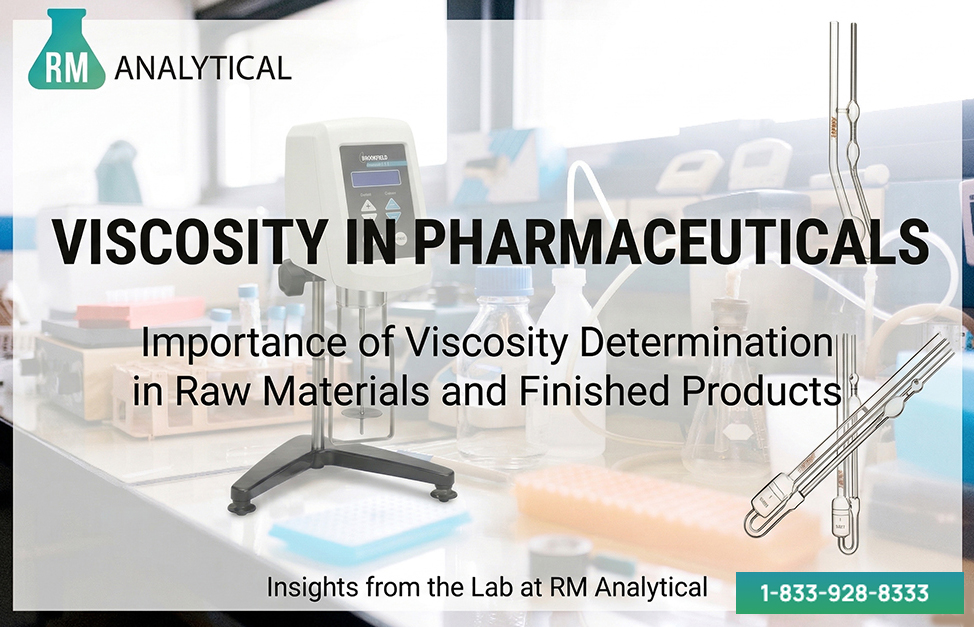
Viscosity is one of the most critical and often underappreciated quality attributes in pharmaceutical development and manufacturing. It is a key performance indicator that directly influences formulation behavior and final product performance. During manufacturing, viscosity governs how materials mix, flow, transfer, and fill, impacting everything from scale-up and equipment selection to batch reproducibility. In formulation design, it plays a central role in ensuring uniform drug distribution, suspension stability, and controlled drug release. For the end user, viscosity ultimately shapes critical attributes such as spreadability, pourability, and ease of administration for both providers and patients. From incoming raw materials and excipients where they help verify suitability for processing, to finished dosage forms where it contributes to stability and therapeutic performance, viscosity serves as a fundamental and reliable indicator of quality, consistency, and fitness for intended pharmaceutical use.
Viscosity defines a fluid’s resistance to flow; where a more viscous fluid exhibits more resistance. In pharmaceutical systems, this fundamental property has significant implications across formulation development, manufacturing, and product performance. It directly impacts how a dosage form behaves during processing, and how it performs throughout its shelf life and administration.
Viscosity influences…
- Dose uniformity by ensuring consistent dispersion of active ingredients
- Physical and chemical stability by helping control phase separation, sedimentation, and molecular mobility
- Drug release characteristics, particularly in modified or controlled-release systems
- Suspension behavior, including sedimentation rate and ease of redispersion
- Texture, pourability, spreadability, and overall patient satisfaction
Because of these interconnected effects, even small deviations in viscosity can lead to meaningful changes in formulation behavior. Such variations may ultimately affect therapeutic performance—a non-uniform or unstable dose can have catastrophic consequences for patient wellbeing. This is why viscosity is considered a critical quality attribute in pharmaceutical development and manufacturing.
Viscosity in Raw Materials and Excipients
Viscosity testing is routinely performed on liquid and semi-solid raw materials, particularly excipients such as:
- Xanthan Gum
- Carbomer Homopolymer
- Carboxymethylcellulose Sodium
- Hypromellose
- Etc.
For these materials, viscosity acts as a critical quality indicator to ensure:
- Batch-to-batch consistency
- Conformance to pharmacopeial or internal specifications
- Absence of degradation, dilution, or contamination
- Suitability for intended formulation use
Incoming quality control (IQC) programs often include viscosity measurements as part of raw material release testing, helping to support supplier qualification and reduce variability in downstream processes.
Viscosity in Finished Pharmaceutical Products
Viscosity is equally important in finished dosage forms where it often becomes a critical quality attribute (CQA). It is especially relevant for:
- Oral liquids (syrups, suspensions, solutions)
- Topical gels and creams
- Ophthalmic preparations
- Semi-solid formulations and emulsions
- Viscous injectables and suspensions
In these products, viscosity directly impacts:
- Dose accuracy during administration
- Physical stability, including prevention of sedimentation or phase separation
- Drug distribution uniformity
- Rheological behavior, affecting how the product flows and spreads
- Patient experience, including ease of use and acceptability
As a result, viscosity is commonly included in both release specifications and stability studies for finished products.
Impact of Viscosity on Manufacturing and Process Performance
Beyond formulation and product quality, viscosity also plays a critical role in manufacturing operations:
- Influences mixing efficiency and homogenization
- Affects pumpability and transfer of materials through equipment
- Impacts filling accuracy during packaging operations
- Determines filtration rates and processing behavior
- Can influence scale-up and tech transfer outcomes
Inconsistent viscosity can lead to process deviations, equipment strain, reduced efficiency, and in some cases, batch rejection.
USP 〈911〉 and 〈912〉: Standardized Approaches for Viscosity Determination
USP 〈911〉 and 〈912〉 are well-recognized and widely accepted pharmacopeial techniques for viscosity determination, providing standardized methods for evaluating both Newtonian and non-Newtonian systems.
USP 〈911〉 – Capillary Viscometry
USP 〈911〉 is used for Newtonian fluids, where viscosity remains constant regardless of shear rate.
This method involves measuring the flow time of a liquid through a calibrated capillary viscometer. Strict temperature control (±0.1°C) is maintained throughout testing. A minimum flow time of 200 seconds is ensured for accuracy’s sake. The method includes calibration using standards of known viscosity to determine the viscometer constant, followed by calculation of kinematic and dynamic viscosity using established equations. Repeated measurements are performed to ensure precision.
This technique is particularly suitable for low-viscosity liquids such as simple solutions and many liquid excipients.
USP 〈912〉 – Rotational Viscometry
USP 〈912〉 is designed for non-Newtonian systems, where viscosity varies with applied shear.
This includes complex formulations such as:
- Gels
- Creams and ointments
- Suspensions
- Emulsions
- Polymer-based systems
Rotational viscometers measure viscosity by evaluating the torque required to rotate a spindle in the sample at defined speeds. This allows characterization of viscosity under different shear conditions, providing insight into rheological behavior such as shear thinning or shear thickening.
Unlike capillary methods, rotational viscometry enables a more comprehensive understanding of how a product behaves during manufacturing, storage, and administration.
Selecting the Appropriate Method
Choosing between USP 〈911〉 and 〈912〉 depends on the nature of the material:
- USP 〈911〉 – Newtonian, low-viscosity fluids (e.g., many excipients and simple solutions)
- USP 〈912〉 – Non-Newtonian, complex formulations (e.g., gels, creams, suspensions)
Using the correct method ensures that the measured viscosity accurately reflects the material’s real-world behavior and supports meaningful quality decisions.
Risks of Inadequate Viscosity Control
Failure to properly evaluate and control viscosity can result in:
- Inconsistent dosing and content uniformity issues
- Physical instability (sedimentation, phase separation)
- Manufacturing inefficiencies and process variability
- Product performance failures
- Regulatory findings, recalls, or compliance issues
Given these risks, viscosity should be treated as a controlled and monitored parameter throughout the product lifecycle.
Best Practices for Viscosity Determination
To ensure robust and reliable viscosity measurement:
- Apply USP 〈911〉 and 〈912〉 methods appropriately
- Maintain strict and consistent temperature control
- Use calibrated and validated instruments
- Perform replicate measurements and monitor %RSD
- Establish scientifically justified specifications
- Integrate viscosity into raw material qualification and finished product release testing
- Conduct trend analysis during stability studies
Viscosity determination is a fundamental component of pharmaceutical quality assurance. From raw material to finished product, viscosity testing provides critical insight into material behavior, process performance, and product quality.
By leveraging standardized pharmacopeial methods such as USP 〈911〉 and 〈912〉, manufacturers can ensure consistent and reproducible viscosity measurements across a wide range of pharmaceutical applications – ultimately safeguarding product quality and patient safety.
The RMA team brings years of hands-on experience supporting viscosity testing and characterization for raw materials and finished pharmaceutical products. Our scientists and quality professionals work closely with clients to develop fit-for-purpose viscosity testing strategies tailored to specific materials, dosage forms, and rheological requirements, ensuring that each method aligns with the behavior of the system being evaluated.
All viscosity testing is conducted with strict adherence to cGMP requirements in an FDA-registered and FDA-audited laboratory, ensuring data integrity, regulatory compliance, and confidence in the accuracy and reproducibility of our results.
Whether you are evaluating the viscosity of incoming excipients, assessing batch-to-batch consistency, troubleshooting formulation or process challenges, or generating data to support regulatory submissions, RMA provides reliable and compliant viscosity testing solutions to support your needs.
Contact us today: engage@rawmaterialanalytical.com
Call us: 833-928-8333
Recent Blogs and News

Background & Fundamental Knowledge of Chromatographic Systems Outlined in USP – Chapter <621>
A Brief History & Introduction - By Ardit Ukella Chromatography is the separation of a mixture based on the differing properties of its analytes, and how those analytes interact with a stationary and mobile phase. The term “chromatography” is named after the Greek words for “color” and “write”. Botanist Mikhail Tsvet is often credited with creating the first form of chromatography. Wanting a way to separate the colorful...
Importance of Viscosity Determination in Raw Materials and Finished Products in Pharmaceuticals
Viscosity is one of the most critical and often underappreciated quality attributes in pharmaceutical development and manufacturing. It is a key performance indicator that directly influences formulation behavior and final product performance. During manufacturing, viscosity governs how materials mix, flow, transfer, and fill, impacting everything from scale-up and equipment selection to batch reproducibility. In formulation design, it plays a central role in ensuring...

The Critical Role of Raw Material Analysis in Pharmaceuticals
Raw material and finished product testing isn't optional in pharma; it's federal law. Learn why the FDA mandates these crucial tests for patient safety and cGMP compliance