
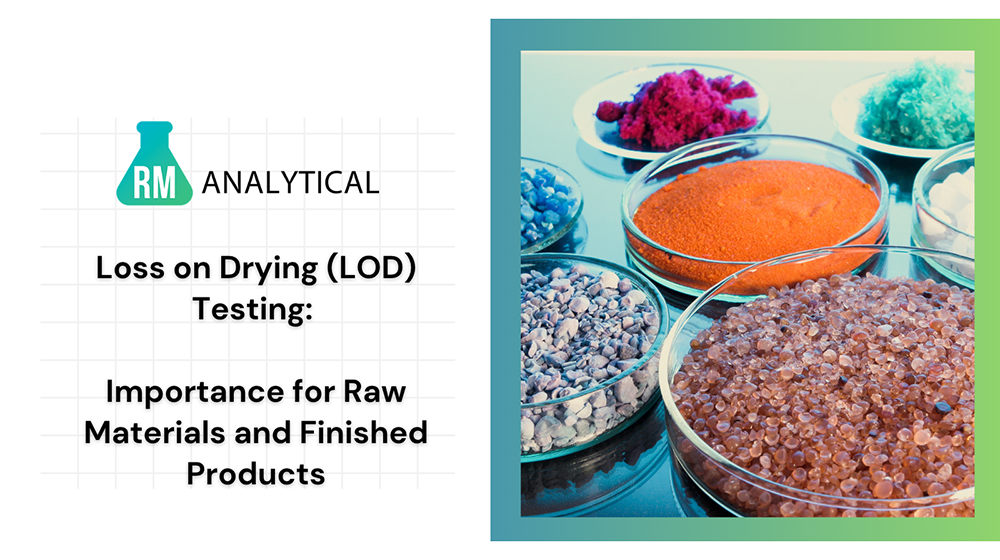
What is Loss on Drying (LOD)?
- Loss on Drying (LOD) is a widely used analytical technique to determine the amount of moisture and volatile substances present in a material. It measures the weight loss of a sample when heated under controlled conditions.
- According to USP <731> Loss on Drying, LOD is defined as the amount of volatile matter of any kind driven off under specified temperature and time conditions. This includes not only water but also residual solvents and other volatile components, making LOD a comprehensive and practical method for routine quality control.
- A key aspect of LOD testing is that results are method-dependent. The specified temperature and time conditions directly influence the outcome, which is why these parameters must be carefully controlled and reported.
Why Loss on Drying Testing is Important
- Ensuring Raw Material Quality
-
- Raw materials are the foundation of pharmaceutical manufacturing, and variability in moisture or volatile content can significantly impact performance. Excess moisture can lead to poor flowability, clumping, and increased microbial risk, while overly dry materials may affect processing characteristics. LOD testing ensures that materials meet predefined specifications before entering production, supporting consistency and reliability.
- Improving Manufacturing Efficiency
-
- Moisture levels directly influence manufacturing processes such as blending, granulation, and compression. Variability in LOD can result in inconsistent granule formation, poor tablet compressibility, and extended drying times. By maintaining controlled LOD values, manufacturers can reduce variability, improve process efficiency, and ensure smoother production operations.
- Supporting Product Stability and Shelf Life
-
- In finished products, volatile content plays a critical role in long-term stability. Excess moisture can accelerate degradation pathways, alter physical properties such as hardness and dissolution, and increase the risk of microbial growth. LOD testing helps ensure that finished products remain within acceptable limits, preserving quality and efficacy throughout their shelf life.
- Meeting Regulatory Expectations
-
- LOD testing is widely recognized in pharmacopeial standards such as USP <731> Loss on Drying and is commonly included in material and product specifications. It supports batch release decisions, stability studies, and regulatory submissions. Consistent and well-documented LOD data demonstrates a robust quality system aligned with regulatory expectations.
Key Method Considerations per USP 〈731〉
- To ensure accurate and reproducible results, USP 〈731〉 provides detailed procedural guidance.
- Typically, a 1–2 gram sample is used unless otherwise specified. The sample should be thoroughly mixed and, if necessary, reduced in particle size to ensure uniform drying. A pre-dried, tared glass-stoppered weighing bottle is used, and the sample is evenly distributed to allow consistent exposure to heat.
- Drying is performed under specified temperature and time conditions, with the temperature controlled within ±2°C of the stated value. Because LOD results depend on these parameters, maintaining strict control is essential.
- When a monograph specifies "dry to constant weight," drying continues until two consecutive weighings differ by no more than 0.50 mg per gram of sample, typically after an additional hour of drying. After heating, samples are cooled in a desiccator to prevent moisture reabsorption before final weighing.
- USP 〈731〉 also outlines special considerations: materials that melt are pre-dried below their melting point; tablets and capsules require representative composite sampling; vacuum drying or desiccators may be used when specified; and desiccant effectiveness must be ensured. These details highlight that LOD is a controlled analytical procedure, not simply a drying step.
What Does LOD Measure?
- LOD captures the total loss of volatile substances, including water (free and bound), residual solvents, and other volatile impurities. This broad measurement makes LOD particularly valuable for routine quality control, where a comprehensive understanding of volatile content is needed rather than compound-specific analysis.
Applications of Loss on Drying
- LOD testing is widely applied across multiple industries, including pharmaceuticals (APIs, excipients, and finished dosage forms), nutraceuticals, food products, chemicals and polymers, and cosmetics. Its versatility makes it a fundamental analytical tool across quality control laboratories.
Advantages and Limitations
- LOD is a simple, cost-effective, and widely accepted method that provides quick and actionable results. Its broad applicability makes it a staple in quality control laboratories. However, it is non-specific and does not distinguish between water and other volatile components, and higher drying temperatures may lead to thermal degradation in certain materials. Despite these limitations, it remains highly effective for routine testing.
- Loss on Drying (LOD) testing is a fundamental and highly effective quality control tool across the pharmaceutical product lifecycle. Guided by standards such as USP 〈731〉, it provides a reliable approach to measuring total volatile content under controlled conditions.
- From ensuring raw material consistency to maintaining finished product stability, LOD testing helps manufacturers reduce variability, improve efficiency, and meet regulatory expectations. In an environment where even small variations can have significant consequences, LOD remains an essential analytical technique for maintaining product quality and integrity.
How RMA Supports Loss on Drying (LOD) and Moisture Analysis
- The RMA team brings extensive experience in supporting Loss on Drying (LOD) and moisture analysis for pharmaceutical raw materials and finished products. Our scientists and quality professionals collaborate closely with clients to develop fit-for-purpose LOD methods, ensuring that drying conditions are aligned with the specific characteristics of each material.
- All testing is performed in accordance with Current Good Manufacturing Practice (cGMP) requirements in an U.S. Food and Drug Administration-registered and audited laboratory, ensuring high standards of data integrity, accuracy, and reproducibility.
- Whether you are evaluating incoming raw materials, monitoring batch-to-batch consistency, investigating stability concerns, or generating data for regulatory submissions, RMA provides reliable, compliant, and scientifically sound LOD testing solutions tailored to your needs.
- Contact us today: engage@rawmaterialanalytical.com
- Call us: 833-928-8333
Recent Blogs and News
Elemental Impurities Testing: Understanding USP <232>, USP <233>, and ICH Q3D
Elemental impurities in drug products can enter the manufacturing process through several pathways: as residual catalysts intentionally introduced during synthesis, as contaminants from interactions with processing equipment or container/closure systems, or as impurities already present in raw material components. Unlike active pharmaceutical ingredients, elemental impurities provide no therapeutic benefit to patients. In fact, they can...
Why Cleaning Validation is Non-Negotiable in Drug Manufacturing
THE FOUNDATION What Is Cleaning Validation in Pharmaceuticals - and Why Does It Matter? When pharmaceutical equipment moves from one production run to the next, the stakes could not be higher. Trace residues of active pharmaceutical ingredients (APIs), cleaning agents, or byproducts can quietly alter a drug's strength, composition, or effectiveness - putting patients at...
Understanding USP 〈311〉 Alginates Assay: Reliable Testing Support from RM Analytical
Alginates are widely used pharmaceutical excipients known for their thickening, stabilizing, and controlled-release properties. Because these materials play a critical role in product performance and quality, accurate analytical testing is essential to ensure compliance with pharmacopeial requirements and material specifications. One of the key compendial procedures used to evaluate alginate materials is USP 〈311〉 Alginates...